


A Record-Breaking Year: How 2023 Rewrote Climate History
Buckle up; we’re about to take a deep dive into the climate rollercoaster that was 2023. Spoiler alert: it broke more records than your favourite vinyl collection.
2023 clinched the title for the hottest year on record (since we started measuring temperatures back in 1850). A scorching 14.98°C global average firmly confirms global warming. But this isn’t just about numbers; it’s a wake-up call from our climate.
The global average temperature of 14.98°C, surpassing the previous peak in 2016 by 0.17°C, sends a clear signal that our planet is facing unprecedented challenges. The data indicates that 2023 was 0.60°C warmer than the 1991-2020 average and a staggering 1.48°C warmer than 1850-1900. Moreover, the year marked the first time on record that all 365 days exceeded 1°C more than pre-industrial levels.

The oceans played a starring role in 2023’s climate saga. El Niño made its grand entrance as La Niña took a bow (the previous El Niño phenomenon was a driving influence in the record-breaking heat of 2016). High sea surface temperatures, especially in the North Atlantic, took centre stage, breaking records and setting the scene for marine heatwaves across the globe. This rise in ocean temperature had catastrophic knock-on effects, including mass loss of marine wildlife.
Europe wasn’t spared the heat either, with 2023 standing as the second-warmest year for the continent. The year witnessed the warmest September on record; temperatures were above average for 11 out of 12 months. Our summer was the fifth hottest on record, coming in at 0.83°C above average temperatures for that time of year. However, we felt the heat more in the winter, with December 2022 – February 2023 marking the second-warmest in the season’s history.
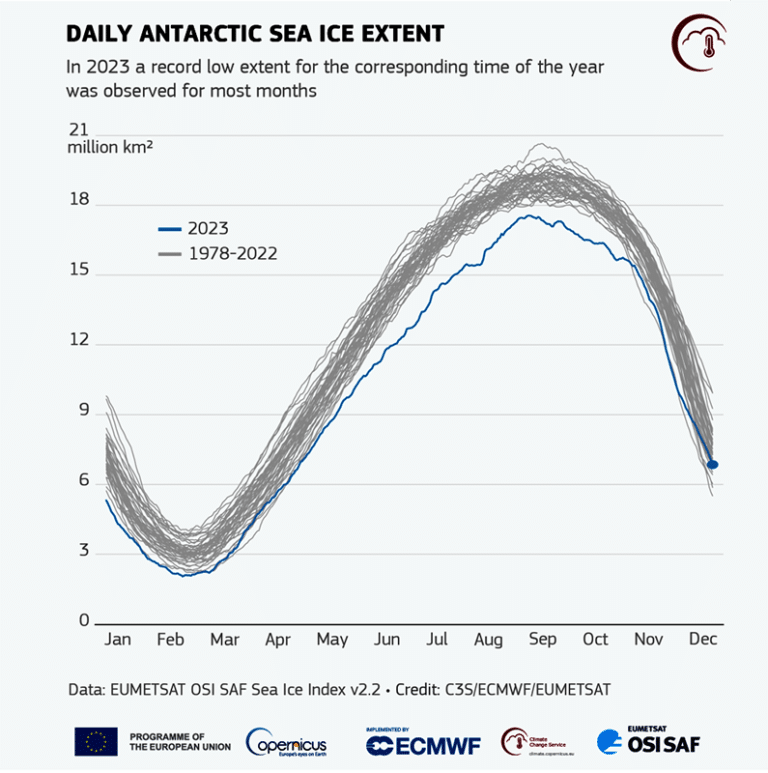
Antarctica’s sea ice hit its lowest levels in eight months, while the Arctic hit record lows in March. Sea ice is frozen ocean water that forms, grows, and melts entirely in the ocean. Changes in the amount of sea ice can disrupt normal ocean circulation, thereby leading to changes in the global climate. Even a small increase in temperature can lead to greater warming over time, making the polar regions the most sensitive areas to climate change on Earth.
According to CAMS (Copernicus Atmosphere Monitoring Service) estimates, global wildfires in 2023 generated around 2100 megatonnes of carbon emissions. This is a 30% increase on what was estimated for the year, largely impacted by the intense fires in Canada. But it wasn’t just the West Coast which was ravished by flames, Greece experienced the worst wildfires that the country has recorded in 20 years.
At least 12,000 people – 30% more than in 2022 – lost their lives due to floods, wildfires, cyclones, storms, and landslides globally in 2023, according to a new analysis from Save the Children. The research suggests that it’s those on the lowest income who are most affected by these disasters, with almost half (45%) of those killed (5,326) coming from countries that are responsible for less than 0.1% of the world’s emissions.

Concentrations of carbon dioxide and methane in the atmosphere reached record levels last year, emphasising the urgency of addressing our carbon footprint. It’s time we acknowledged our collective responsibility. Amidst these challenges, there are rays of hope. Initiatives focused on sustainable practices aim to be part of the solution. These milestones are a stark reminder that our planet is navigating uncharted climatic territory, but by embracing environmental practices, and supporting eco-friendly initiatives, we can steer towards a more resilient and sustainable future for all.